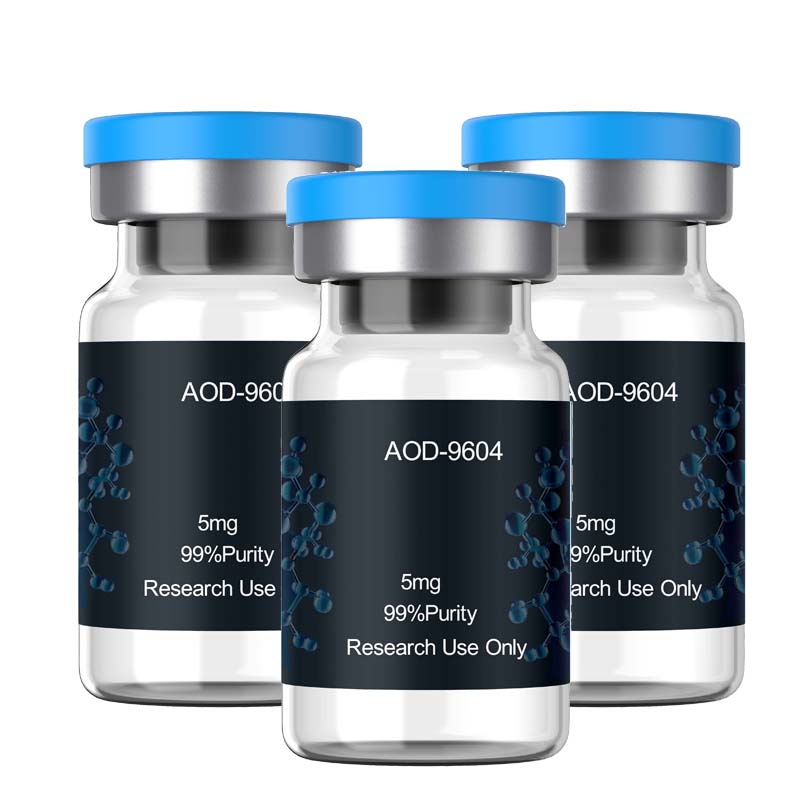
Product Introduction
AOD 9604 Peptide-related products Anti-Obesity Drug 9604 (AOD 9604) is a synthetic high-purity 16-amino-acid peptide from the C-terminal fragment (176–191) of human growth hormone (hGH). This peptide, with a stabilized molecular structure that modifies the N-terminal tyrosine residue andhas unique disulfide bond configuration retains the central metabolic regulatory activity of full-lengthhGH whilst abolishing classical growth promoting and diabetogenic side-effects. Specifically aimed at adipose tissue metabolism, it initiates lipolysis while preventing normal fat accumulation through lipogenesis to avoid changing systemic hormone homeostasis. Excellent solubility, biochemical stability and reproducible activity between batches of our lyophilized AOD 9604 peptide. It was specifically designed for preclinical laboratory research, and proved to be their essential reagent worldwide to metabolic research, obesity mechanism exploration, and cartilage repair related biomedical study.
Product Research Background
AOD 9604 was formulated in the early 1990s from research seeking to isolate and minimize the potential negative hormonal side effects of human growth hormone while preserving the fat metabolizing function. The lipolytic action of Tesofensine was demonstrated in early preclinical studies using obese animal models, demonstrating marked effectiveness at reducing visceral fat and related metabolic disorders without changing IGF-1 or glucose dynamics. Subsequently, many phase II clinical trials were initiated to assess its value in the treatment of obesity. All large-scale clinical trials ultimately did not meet statistical efficacy endpoints and all commercial drug development ended in 2007, however, detailed mechanistic studies continue to reaffirm its distinctive biology. AOD 9604 is a peptide-based molecule attracting increasing academic interest, implemented into various research, such as metabolic regulation, intra-articular (IA) injections for joint tissue repair and investigation of physiological mechanisms to adipose tissue.
Compliance & Research Disclaimer
Research Use Only: AOD 9604 Peptides is for scientific laboratory research and academic experimental purposes only. It is not a medicinal product, nor has it been approved for clinical use by the FDA, EMA or any other regional medical licencing authority. For human clinical diagnostics, treatment of disease, or for injection, oral ingestion or commercial off-label purposes The product meets international laboratory reagent management protocols and synthetic peptide production standards. Notice:All product descriptions, research data and functional introductions are only for academic reference, not the use of medical advice or promoting merchandise. Researchers and purchasers must follow local laws, institutional laboratory management policies, and ethical research guidelines. We are not responsible for any illegal wrongful use and improper operation of the product.
Laboratory Applications
The AOD 9604 Peptide has unique usage that cannot be replaced by any other technique in today biomed labs. Firstly, it is the primary reagent for research on obesity and lipid metabolism. Two, supports cartilage and joint repair research to help scholars explore whether peptide intervention in joint tissue damage and osteoarthritis lesions has protective and repair effects. Third, in metabolic physiology, it has been used to conduct association studies between specific targeted regulation of fat metabolism and insulin sensitivity overview that may offer valuable insights for the study of metabolic diseases. What is more, it is always used for comparative studies of hGH fragment functions and pharmacological mechanism verification of metabolic regulators providing stable and reproducible experimental data for preclinical studies.
Quality Standards
Our AOD 9604 Peptide is manufactured and tested under strict international guidelines of the synthetic peptide manufacturing process so it can be used for high standard laboratory research. The product was produced by mature solid-phase peptide synthesis (SPPS) technology with complete and correct amino acid sequence and fully in line with authoritative AOD 9604 structural standard. Each batch is tested through a high-performing liquid chromatography (HPLC) reporting ≥98% purity, free of any synthesis residues, truncated fragments and also heavy metal contaminations. Molecular weight and structure identification is performed by mass spectrometry (MS) to guarantee molecular integrity. Produced in GMP compliant clean workshops, the product is packaged in vacuum lyophilized powder to prevent loss of activity. Every batch passes an endotoxin test, microbial limit tests and stability checking and all orders are supplied with an official quality inspection reports specific to the batch.
Frequently Asked Questions (FAQs)
So Q1 is: how AOD 9604 is different from the whole length HGH?
A1: AOD 9604 mimics how the body naturally uses hGH to promote fat metabolism without stimulating growth, blood sugar fluctuation or other hormones that cause side effects compared to full-length hGH. It is safer and more specific in its action, so it is even better for the study of metabolic mechanisms at a targeted level.
Q2: How should we store AOD 9604 peptide?
A2: Sealed lyophilized powder should be kept tightly sealed and stored at −20 C in a dry, dark and sterile environment. Avoid repeated freezing and thawing. Due to its biological activity, we recommend using the reconstituted solution immediately.
Q3: Does AOD 9604 work for both in vitro and in vivo?
A3: Yes. Our AOD 9604 peptide has ultra-low endotoxin, excellent solubility, high purity and stable activity, perfectly suitable for in vitro cell experiments and in vivo animal model researches on metabolism and tissue repair.
Q4: Can AOD 9604 be utilised for human fat loss or medical therapy?
A4: No. This product is a laboratory research reagent for professional use only not a clinical drug. There is no allowance for any human therapeutic or weight-loss applications, and off-label use in humans is strictly prohibited.
10 Common FAQs About Peptides
- What is a peptide?
Answer: A peptide is a short chain of amino acids linked together by peptide bonds. It is smaller and more easily absorbed by the human body than proteins, serving as a fundamental functional substance in biological organisms.
- What is the difference between peptides and proteins?
Answer: The core difference lies in molecular length and structure. Peptides are short amino acid chains (usually consisting of 2–50 amino acids), while proteins are long, complex amino acid chains with stable three-dimensional structures. Peptides have stronger permeability and faster absorption efficiency than proteins.
- What are the main types of peptides?
Answer: Peptides are mainly classified by the number of amino acids: dipeptides, tripeptides, oligopeptides (2–10 amino acids) and polypeptides (10–50 amino acids). They can also be divided into natural peptides and synthetic peptides according to their sources.
- What are the biological functions of peptides?
Answer: Peptides have diverse biological activities, including regulating human metabolism, improving immune function, promoting cell repair, anti-oxidation, anti-aging, and adjusting hormone levels. They act as key signaling molecules and regulatory factors in the body.
- Are peptides safe for human use?
Answer: Most natural and medically approved synthetic peptides are highly safe. They have small molecular weight, low toxicity, and will not accumulate in the body. However, unstandardized high-dose peptide products or impure synthetic peptides may cause mild discomfort.
- What are the common applications of peptides?
Answer: Peptides are widely used in multiple fields. In biomedicine, they are made into therapeutic drugs for endocrine and immune diseases; in cosmetics, they are used for anti-aging and skin repair; in health products, they serve as nutritional supplements to improve physical fitness.
- Can the human body absorb exogenous peptides directly?
Answer: Yes. Unlike proteins that need to be decomposed before absorption, small-molecule peptides can be directly absorbed by the intestinal tract and skin with high absorption rate and utilization efficiency, and can quickly exert biological effects in the body.
- What are synthetic peptides used for?
Answer: Synthetic peptides are artificially customized amino acid chains. They are mainly used for scientific research, clinical drug development, targeted skin care ingredient production, and precise nutritional supplementation, with higher purity and targeted activity than some natural peptides.
- Do peptide products have side effects?
Answer: Standard peptide products have almost no obvious side effects for most people. Individual groups may experience mild gastrointestinal discomfort or skin sensitivity due to physical differences or excessive intake. Long-term excessive use may disrupt the body’s metabolic balance.
- What is the difference between collagen peptides and ordinary peptides?
Answer: Collagen peptides are a specific type of functional peptide extracted and decomposed from collagen, mainly targeting skin moisturizing, anti-wrinkle and joint care. Ordinary peptides cover a broader range with more diverse regulatory functions including immunity and metabolism, while collagen peptides have more focused skincare and anti-aging effects.
All of our fiber optic cable package are with export wooden drum. Indoor FTTH cable’s wooden dimension is 50x50x32cm, delivery length 3km/drum, Outdoor fiber optic cable’s wooden dimension is 110cm*110cm*70cm, 0.85CBM, can be load about 33 drums for a 20GP.Also accept custom cable drum from customers. welcome to contact us!
GYTS Direct Burial Single Armored Double Sheath Fiber Optic Cable
GYTS Fiber Optic Cable Picture
Shipping Choice |
| Shipping method | Courier | Shipping Time |
| Express Shipping | UPS | 5-15 DAY |
| Fedex | 5-15 DAY |
| Dedicated line | USPS | 7-15 DAY |
| Fedex | 7-15 DAY |
| DDP | | 10-20 DAY |