Produkteinführung
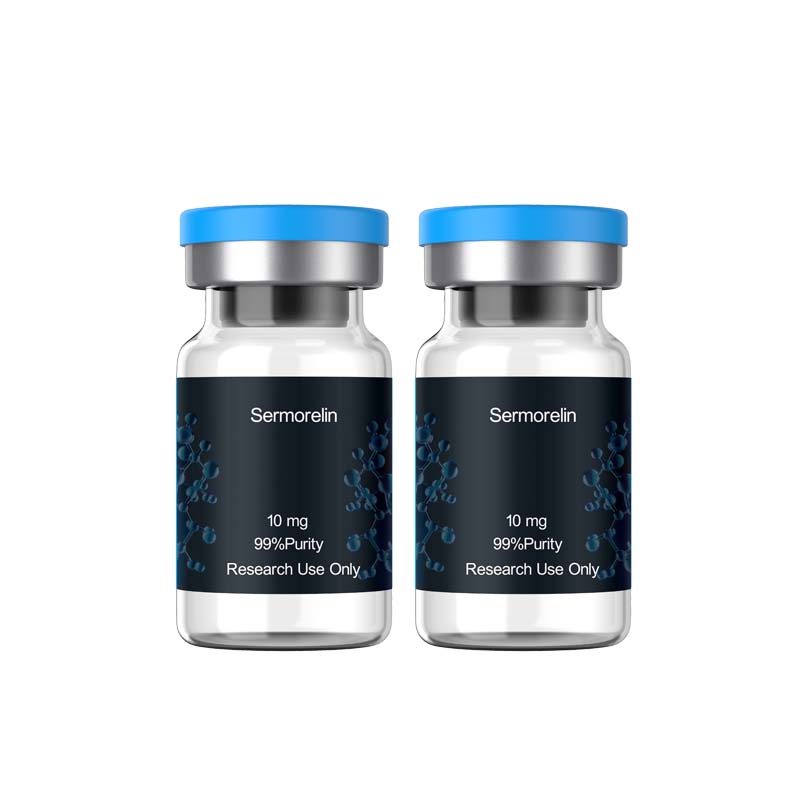
Sermorelin peptide is an acetylated GRF (1-29) also called Sermorelin Acetate, a high-purity synthetic peptide analog of growth hormone-releasing hormone (GHRH) found in humans. Structurally, it comprises the first 29 amino acid residues of the natural GHRH sequence (44-amino-acid GHRH sequence), which was determined to be a minimal bioactive fragment that fully binds and activates human GHRH receptors. This peptide is much more stable, less costly to produce and a reproducible biological activity compared with full-length GHRH (23) having a chemical structure of 3357.92 g/mol. Sermorelin is available in bulk in clinical and laboratory research, and it essentially produces GH secretagogues by exerting a stimulating effect on the activity of the anterior pituitary where GH release occurs naturally as an endogenous secretion (via a pulsatile mechanism) without addressing what could be adverse feedback inhibition risks associated with exogenous failures to provide ideal supplementation for GH. It has emerged as a central research instrument in the fields of endocrinology, metabolic physiology, and aging-related biomedical research.
Hintergrund der Produktforschung
Sermorelin was discovered as part of peptide research in the 1980s, when scientists first isolated and sequenced human GHRH from endogenous sources. Pharmacological studies demonstrated that the initial 29 amino acid N-terminal [1-29] fragment of GHRH retained full physiological activity, whilst downstream C-terminal fragments had no significant effect on receptor binding and signal transduction. This important discovery set the stage for the development of Sermorelin. This was followed by a number of clinical and preclinical trials in subsequent decades that confirmed its safety and efficacy in governing the GH axis. After gaining FDA approval for clinical adjuvant diagnosis and growth hormone deficiency investigations, Sermorelin was slowly removed from commercial clinical usage due to market adjustment needs instead of some sort of parameters rather than safety problems. To date, one of the most investigated GHRH analogs with extensive published literature supporting its use in elucidating growth regulation, metabolic homeostasis, and hormonal changes accompanying aging.
Einhaltung & Haftungsausschluss für Forschung
This peptide product of Sermorelin is intended solely for use in scientific laboratory research and academic study. Human clinical use, medical diagnosis, treatment or personal consumption is not approved. The product meets the internationally accepted specifications for peptide research reagent production and regional laboratory material management regulations. The products and data that you have provided in this section on the site are for educational writing or experimental testing purposes only and not intended for commercial medical use or non-label use. It is incumbent on researchers and purchasers to comply fully with local laws, regulations and institutional laboratory management requirements. We disclaim all liabilities arising from any unauthorized clinical application, improper use or unlawful operation of the product. No product description and research data represent or guarantee any medical efficacy or therapeutic effect.
Laboranwendungen
Sermorelin peptide is widely used as an essential research reagent in many modern biomedical laboratories with standardized applications for various research directions. Firstly, it has been extensively applied in the study of GH axis physiology which enables scholars to analyze the regulatory mechanism of hypothalamic-pituitary growth hormone secretion and explore endogenous hormones constituting a feedback regulation loop between various levels of intra- and extra-brain nuclei. Secondly, it has a role in research of growth hormone deficiency and developmental disorders, providing experimental data for in-depth studies on the pathogenesis and intervention strategies of abnormal stature. Dritte, it is used in the field of aging biology to determine whether age-related decline in GH secretion contribute to metabolic aging and/or the loss of organ function or body composition. Sermorelin is also used in experiments to detect pituitary reserve function, and for studies of metabolic regulation using in vitro and/or animal models which assist researchers when validating the effect of peptide intervention on cell growth activity, lipid metabolism and energy balance. It has biological effects that are stable and repeatable, which ensures high reliability for experimental data.
Qualitätsstandards
We follow international standards for peptide production and determination to supply high quality options for research use only. Your product has a normal molecular formula of C149H246N44O42S and an amino acid sequence as follows, with complete concordance to the authoritative GRF (1-29) specification. Immune defence efficacy for all batches: HPLC-tested with guaranteed purity - ≥ 98% (free from irrelevant peptide fragments, impurities and heavy metal residues.) The first verification of molecular weight and structure provides the verifying point for every batch block through mass spectrometry (MS). It is produced at a GMP compliant clean laboratory, supplied in standardised lyophilized powder packaging to prevent degradation and contamination. Before delivering, it is stringently checked for microbial limit testing, endotoxin detection and stability testing. With each batch, a full quality inspection report — purity, structure verification results and safety test indicators are all provided so that you can guarantee experimental consistency and repeatability.
Häufig gestellte Fragen (FAQs)
Q1: What are its 3 main benefits compared to full-length GHRH? Antwort 1: Sermorelin is a minimal active fragment of GHRH with better chemical stability, longer half-life of degradation and more stable biological activity in experiment. As it is less expensive, more stable and easier to store and transport than full-length GHRH, it is more appropriate for long-term use and large-scale laboratory studies.
Q2: Under what conditions should you store Sermorelin peptide?
Q2 — How do you store the lyophilized powder? A2: The lyophilized powder should be dry, dark and steriled in -20 °C and avoid repeated freezing–thawing. After reconstitution with sterile water, it should be used as soon as possible and can only be stored at a low temperature in refrigerator for a short time (i.e., activity loss).
Q3: Is it appropriate for in vivo and in vitro experiments?
A3: Ja. It has stable biological activity and low endotoxin, which meets the requirement of mainstream biomedical experiments: Our high-purity Sermorelin can be applied to in vitro cell-level mechanism research experiments and in vivo animal model experimental research through various routes of administration.
Q4: Is your product for use in human medicine?
A4: Absolutely not. Disclaimer: This product is a professional laboratory research reagent only, not a pharmaceutical product. It does not allow for any human body injection, treatment or clinical auxiliary application.
10 Häufig gestellte Fragen zu Peptiden
- Was ist ein Peptid??
Antwort: Ein Peptid ist eine kurze Kette von Aminosäuren, die durch Peptidbindungen miteinander verbunden sind. Es ist kleiner und wird vom menschlichen Körper leichter aufgenommen als Proteine, dient als grundlegende funktionelle Substanz in biologischen Organismen.
- Was ist der Unterschied zwischen Peptiden und Proteinen??
Antwort: Der Hauptunterschied liegt in der Moleküllänge und -struktur. Peptide sind kurze Aminosäureketten (besteht normalerweise aus 2–50 Aminosäuren), während Proteine lang sind, komplexe Aminosäureketten mit stabilen dreidimensionalen Strukturen. Peptide haben eine stärkere Permeabilität und eine schnellere Absorptionseffizienz als Proteine.
- Was sind die wichtigsten Arten von Peptiden??
Antwort: Peptide werden hauptsächlich nach der Anzahl der Aminosäuren klassifiziert: Dipeptide, Tripeptide, Oligopeptide (2–10 Aminosäuren) und Polypeptide (10–50 Aminosäuren). Sie können entsprechend ihrer Herkunft auch in natürliche Peptide und synthetische Peptide unterteilt werden.
- Welche biologischen Funktionen haben Peptide??
Antwort: Peptide haben vielfältige biologische Aktivitäten, einschließlich der Regulierung des menschlichen Stoffwechsels, Verbesserung der Immunfunktion, Förderung der Zellreparatur, Anti-Oxidation, Anti-Aging, und Anpassung des Hormonspiegels. Sie fungieren als wichtige Signalmoleküle und regulatorische Faktoren im Körper.
- Sind Peptide für den menschlichen Gebrauch sicher??
Antwort: Die meisten natürlichen und medizinisch zugelassenen synthetischen Peptide sind äußerst sicher. Sie haben ein geringes Molekulargewicht, geringe Toxizität, und reichert sich nicht im Körper an. Jedoch, Nicht standardisierte hochdosierte Peptidprodukte oder unreine synthetische Peptide können leichte Beschwerden verursachen.
- Was sind die häufigsten Anwendungen von Peptiden??
Antwort: Peptide werden in zahlreichen Bereichen häufig eingesetzt. In der Biomedizin, Sie werden zu therapeutischen Arzneimitteln gegen endokrine und Immunerkrankungen verarbeitet; in der Kosmetik, Sie werden zum Anti-Aging und zur Hautreparatur eingesetzt; bei Gesundheitsprodukten, Sie dienen als Nahrungsergänzungsmittel zur Verbesserung der körperlichen Fitness.
- Kann der menschliche Körper exogene Peptide direkt aufnehmen??
Antwort: Ja. Im Gegensatz zu Proteinen, die vor der Absorption zersetzt werden müssen, Kleinmolekulare Peptide können mit hoher Absorptionsrate und Verwertungseffizienz direkt vom Darmtrakt und der Haut absorbiert werden, und kann schnell biologische Wirkungen im Körper entfalten.
- Wofür werden synthetische Peptide verwendet??
Antwort: Synthetische Peptide sind künstlich angepasste Aminosäureketten. Sie werden hauptsächlich für wissenschaftliche Forschung verwendet, klinische Arzneimittelentwicklung, gezielte Produktion von Hautpflegewirkstoffen, und präzise Nahrungsergänzung, mit höherer Reinheit und gezielter Aktivität als einige natürliche Peptide.
- Haben Peptidprodukte Nebenwirkungen??
Antwort: Standard-Peptidprodukte haben für die meisten Menschen fast keine offensichtlichen Nebenwirkungen. Bei einzelnen Gruppen kann es aufgrund körperlicher Unterschiede oder übermäßiger Einnahme zu leichten Magen-Darm-Beschwerden oder Hautempfindlichkeit kommen. Langfristiger übermäßiger Konsum kann das Stoffwechselgleichgewicht des Körpers stören.
- Was ist der Unterschied zwischen Kollagenpeptiden und gewöhnlichen Peptiden??
Antwort: Kollagenpeptide sind eine spezielle Art von funktionellen Peptiden, die aus Kollagen extrahiert und abgebaut werden, Hauptziel ist die Befeuchtung der Haut, Anti-Falten- und Gelenkpflege. Gewöhnliche Peptide decken ein breiteres Spektrum mit vielfältigeren regulatorischen Funktionen ab, einschließlich Immunität und Stoffwechsel, während Kollagenpeptide eine gezieltere Hautpflege- und Anti-Aging-Wirkung haben.
Alle unsere Glasfaserkabelpakete sind mit einer Export-Holztrommel ausgestattet. Die Holzabmessungen des FTTH-Kabels für den Innenbereich betragen 50 x 50 x 32 cm, Lieferlänge 3 km/Trommel, Die Holzabmessungen des Glasfaserkabels für den Außenbereich betragen 110 cm x 110 cm x 70 cm, 0.85CBM, kann ca. geladen werden 33 Trommeln für 20 GP. Akzeptieren Sie auch kundenspezifische Kabeltrommeln von Kunden. Nehmen Sie gerne Kontakt mit uns auf!
GYTS Direct Burial Einfach gepanzertes Glasfaserkabel mit Doppelmantel
GYTS-Glasfaserkabelbild
Versandauswahl |
| Versandart | Kurier | Lieferzeit |
| Expressversand | UPS | 5-15 TAG |
| Fedex | 5-15 TAG |
| Eigene Leitung | USPS | 7-15 TAG |
| Fedex | 7-15 TAG |
| DDP | | 10-20 TAG |
 Powerae.com