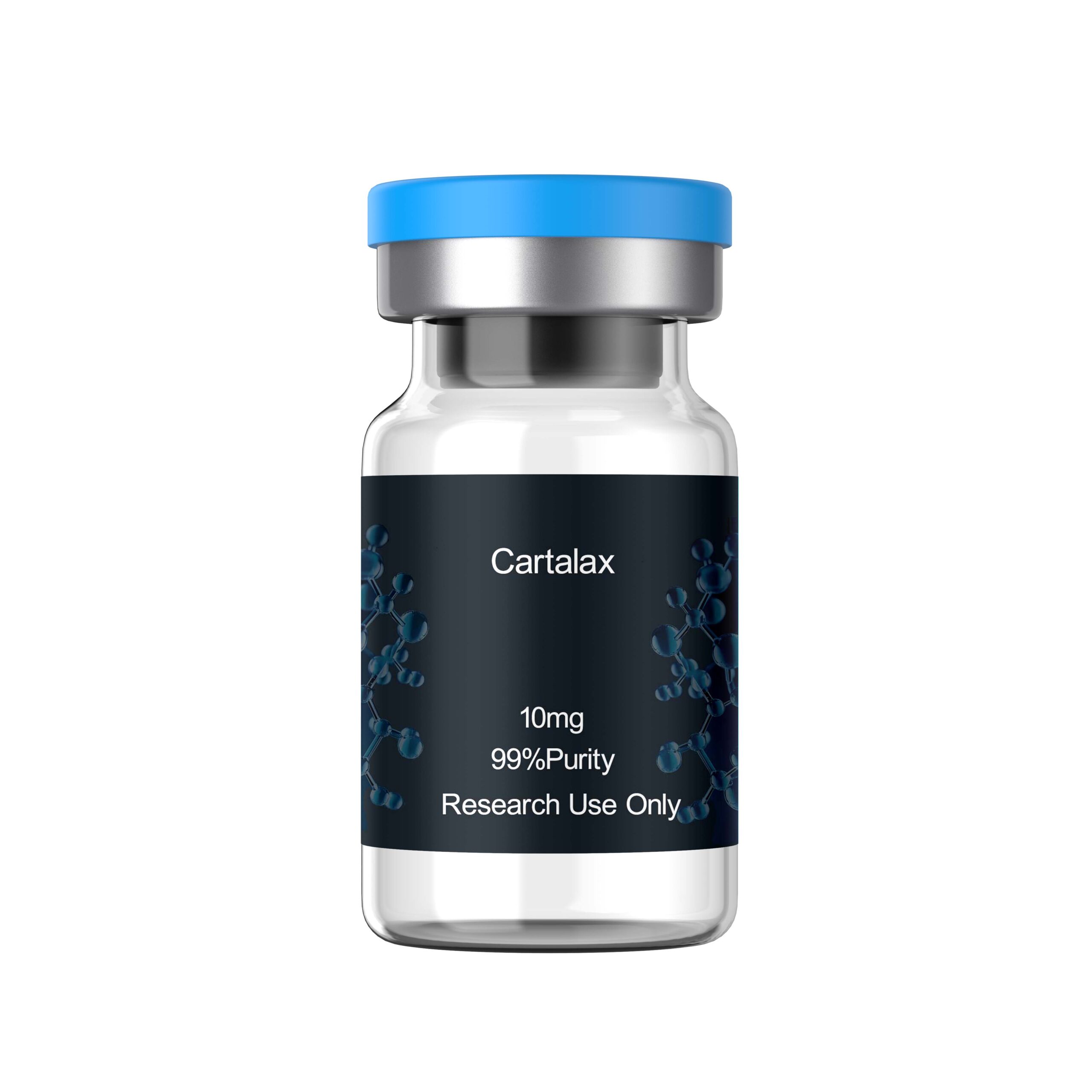
Cartalax Peptide Overview
Generic and Brand Names: Cartalax. It is also referred to as AED tripeptide or the peptide of Khavinson’s family. There are no brand names for Cartalax approved by the FDA or specific treatments involving the drug. Although the drug is sold as a bioregulator in Russia, it is classified as an investigational research peptide everywhere outside the country, with no marketing rights to any medications.
Drug Classification: The drug is a synthetic bioregulatory peptide, a chondroprotective agent that works at the molecular level without other classes of medications.
Chemical Properties: The chemical compound and structure of Cartalax are that of a low-molecular-weight peptide. The drug is made of three amino acids: Alanine, Glutamic acid, and Aspartic acid. Cartalax peptide is similar to the sequence in type XI collagen, which is a vital part of human cartilage. The chemical compound is stable and not destroyed when in the body.
Compliance & Research Disclaimer
Cartalax Peptide is for research use only and academic experimental purposes. It is not registered as a pharmaceutical drug, dietary supplement or an over-the-counter medicine and has no clinical use approval from the FDA, EMA or other regional medical regulatory body. The product cannot be used for human clinical diagnosis, treatment of disease, oral or intravenous administration as well as commercial off-label usage. All of the product details and research data is academic in nature and not intended as medical advice or to be construed as therapeutic claims. Local laws, institutional laboratory-management requirements, and ethical-research standards must be followed by all purchasers and researchers. We shall not be liable for any unauthorized illegal use, improper operation or non-research application of the product.
- Mechanism of Cartalax Work
1.1 Receptor Activation. Activation of Cartalax happens through a special mechanism that doesn’t involve traditional receptors like GPCRs. The drug enters the cell and interacts directly with the gene promoter in the cell nucleus. Thus, the drug works on specific genes responsible for the formation of cartilage, but this does not involve unwanted activation of other receptors, which is an advantage while using the compound.
1.2 Metabolic and physiological impact
In addition to its main chondroprotective effect, Cartalax has other metabolic and physiological effects that are extensively researched in preclinical studies. It increases the production of type II collagen and proteoglycans in order to protect cartilage from destruction, while inhibiting production of local pro-inflammatory cytokines, and thereby reducing the level of low-grade chronic inflammation which causes metabolic diseases. By providing the body with an optimal inflammatory status, it improves peripheral insulin sensitivity and ensures the stability of glucose metabolism in type 2 diabetes patients. It also regulates inflammatory reactions in adipose tissues for prevention of obesity-related metabolic disorders and assists in the measurement of fat mass. In addition to anti-inflammatory and tissue protective effects, it minimizes inflammation and metabolic disorder caused by intermittent hypoxia.
- Applications
All laboratory studies with Cartalax are limited to preclinical research as there are no clinical indications for its usage in humans approved by the FDA.
Research in type 2 diabetes mellitus: It has been investigated in preclinical studies aimed at the diagnosis of insulin resistance and its treatment through the reduction of inflammation in the body in order to make the body react to glucose properly.
Chronic weight management: It has been used in obesity studies to determine the effects of inflammation on metabolism and find ways to improve the organisms' metabolic environment in order to properly treat obesity.
Obstructive sleep apnea: It has been used in studies that focused on the inflammation caused by intermittent hypoxia and its effects on the glucose and lipid metabolism. The results of this research canCore Research in Chondroprotection: A significant element of experimental methodology applied at the development of degenerative processes in cartilage, treatment of intervertebral disk pathologies, and epigenetic regulation of connective tissue.
Dosage and Administration (Laboratory Protocol)
3.1 Route and Frequency
For the administration of Cartalax in everyday laboratory research, subcutaneous injection is the common route chosen since it enables the proper absorption and distribution throughout the body, accordingly giving reliable results in epigenetic and metabolic intervention. It is customary in research to perform administration with the help of the procedure of pulsed cyclical administration with one injection a day for 10-20 días, meaning that 2-3 prescriptions of Cartalax are usually performed per year during chronic experiments.
3.2 Titration
The baseline dose for preclinical animal tests is from 100-150 mcg per day for low levels of gene regulation and inflammation. The medium needed dose for research work is 200-400 mcg per day, reaching the necessary results. The highest available dose is from 500 mcg per day to avoid the alteration in gene expression. There are no established protocols for the usage of Cartalax in humans.
3.3 Missed Dose Management
The missed doses of Cartalax do not need to be addressed in standardized protocols. The missed dose is noted in the dose log where the timings of missing doses have to be kept, cycles being maintained. The results will be achieved without compensating for the dose because such procedures lead to false modifications of results in gene regulation and intervention processes.
- Dosage Forms
The only available form of research-grade Cartalax is the lyophilized powder that must be done correctly. The reconstitution procedure with sterile water is carried out before the injection. There are no available oral forms or injections.
- FDA Regulatory Status
The Food and Drug Administration has not approved Cartalax peptide for any purposes and considers it only an experimental research peptide without the possibility of commercial sales. The Food and Drug Administration does not allow the use of Cartalax in humans.
10 Preguntas frecuentes comunes sobre los péptidos
- ¿Qué es un péptido??
Respuesta: Un péptido es una cadena corta de aminoácidos unidos entre sí por enlaces peptídicos.. Es más pequeño y el cuerpo humano lo absorbe más fácilmente que las proteínas., Sirviendo como sustancia funcional fundamental en los organismos biológicos..
- ¿Cuál es la diferencia entre péptidos y proteínas??
Respuesta: La diferencia principal radica en la longitud y la estructura molecular.. Los péptidos son cadenas cortas de aminoácidos. (generalmente consta de 2 a 50 aminoácidos), mientras que las proteínas son largas, cadenas de aminoácidos complejas con estructuras tridimensionales estables. Los péptidos tienen una permeabilidad más fuerte y una eficiencia de absorción más rápida que las proteínas..
- ¿Cuáles son los principales tipos de péptidos??
Respuesta: Los péptidos se clasifican principalmente por el número de aminoácidos.: dipéptidos, tripéptidos, oligopéptidos (2–10 aminoácidos) y polipéptidos (10–50 aminoácidos). También se pueden dividir en péptidos naturales y péptidos sintéticos según sus fuentes..
- ¿Cuáles son las funciones biológicas de los péptidos??
Respuesta: Los péptidos tienen diversas actividades biológicas., incluyendo la regulación del metabolismo humano, mejorar la función inmune, promoviendo la reparación celular, antioxidante, antienvejecimiento, y ajustar los niveles hormonales. Actúan como moléculas de señalización clave y factores reguladores en el cuerpo..
- ¿Son los péptidos seguros para uso humano??
Respuesta: La mayoría de los péptidos sintéticos naturales y médicamente aprobados son muy seguros.. Tienen un peso molecular pequeño., baja toxicidad, y no se acumulará en el cuerpo. Sin embargo, Los productos peptídicos no estandarizados en dosis altas o los péptidos sintéticos impuros pueden causar una leve molestia..
- ¿Cuáles son las aplicaciones comunes de los péptidos??
Respuesta: Los péptidos se utilizan ampliamente en múltiples campos.. en biomedicina, se convierten en medicamentos terapéuticos para enfermedades endocrinas e inmunes.; en cosmetica, Se utilizan para antienvejecimiento y reparación de la piel.; en productos de salud, Sirven como complementos nutricionales para mejorar la condición física..
- ¿Puede el cuerpo humano absorber péptidos exógenos directamente??
Respuesta: Sí. A diferencia de las proteínas que deben descomponerse antes de su absorción., Los péptidos de molécula pequeña pueden ser absorbidos directamente por el tracto intestinal y la piel con una alta tasa de absorción y eficiencia de utilización., y puede ejercer rápidamente efectos biológicos en el cuerpo..
- ¿Para qué se utilizan los péptidos sintéticos??
Respuesta: Los péptidos sintéticos son cadenas de aminoácidos modificadas artificialmente.. Se utilizan principalmente para investigaciones científicas., desarrollo clínico de fármacos, producción específica de ingredientes para el cuidado de la piel, y una suplementación nutricional precisa, con mayor pureza y actividad específica que algunos péptidos naturales.
- ¿Los productos peptídicos tienen efectos secundarios??
Respuesta: Los productos peptídicos estándar casi no tienen efectos secundarios obvios para la mayoría de las personas.. Los grupos individuales pueden experimentar molestias gastrointestinales leves o sensibilidad en la piel debido a diferencias físicas o ingesta excesiva.. El uso excesivo a largo plazo puede alterar el equilibrio metabólico del cuerpo..
- ¿Cuál es la diferencia entre los péptidos de colágeno y los péptidos ordinarios??
Respuesta: Los péptidos de colágeno son un tipo específico de péptido funcional extraído y descompuesto del colágeno., dirigido principalmente a la hidratación de la piel, cuidado antiarrugas y articulaciones. Los péptidos ordinarios cubren una gama más amplia con funciones reguladoras más diversas, incluidas la inmunidad y el metabolismo., mientras que los péptidos de colágeno tienen efectos más enfocados en el cuidado de la piel y antienvejecimiento..
Todos nuestros paquetes de cables de fibra óptica tienen tambor de madera de exportación.. La dimensión de madera del cable FTTH para interiores es 50x50x32cm, longitud de entrega 3 km/tambor, La dimensión de madera del cable de fibra óptica para exteriores es de 110 cm x 110 cm x 70 cm., 0.85CBM, se puede cargar 33 tambores para un 20GP. También acepte tambores de cable personalizados de los clientes. bienvenido a contactarnos!
Cable de fibra óptica de doble funda blindado de entierro directo GYTS
Imagen del cable de fibra óptica GYTS
Elección de envío |
| Método de envío | Mensajero | Tiempo de envío |
| Envío expreso | Unión Postal Universal | 5-15 DÍA |
| fedex | 5-15 DÍA |
| Línea dedicada | USPS | 7-15 DÍA |
| fedex | 7-15 DÍA |
| DDP | | 10-20 DÍA |
 Powerae.com