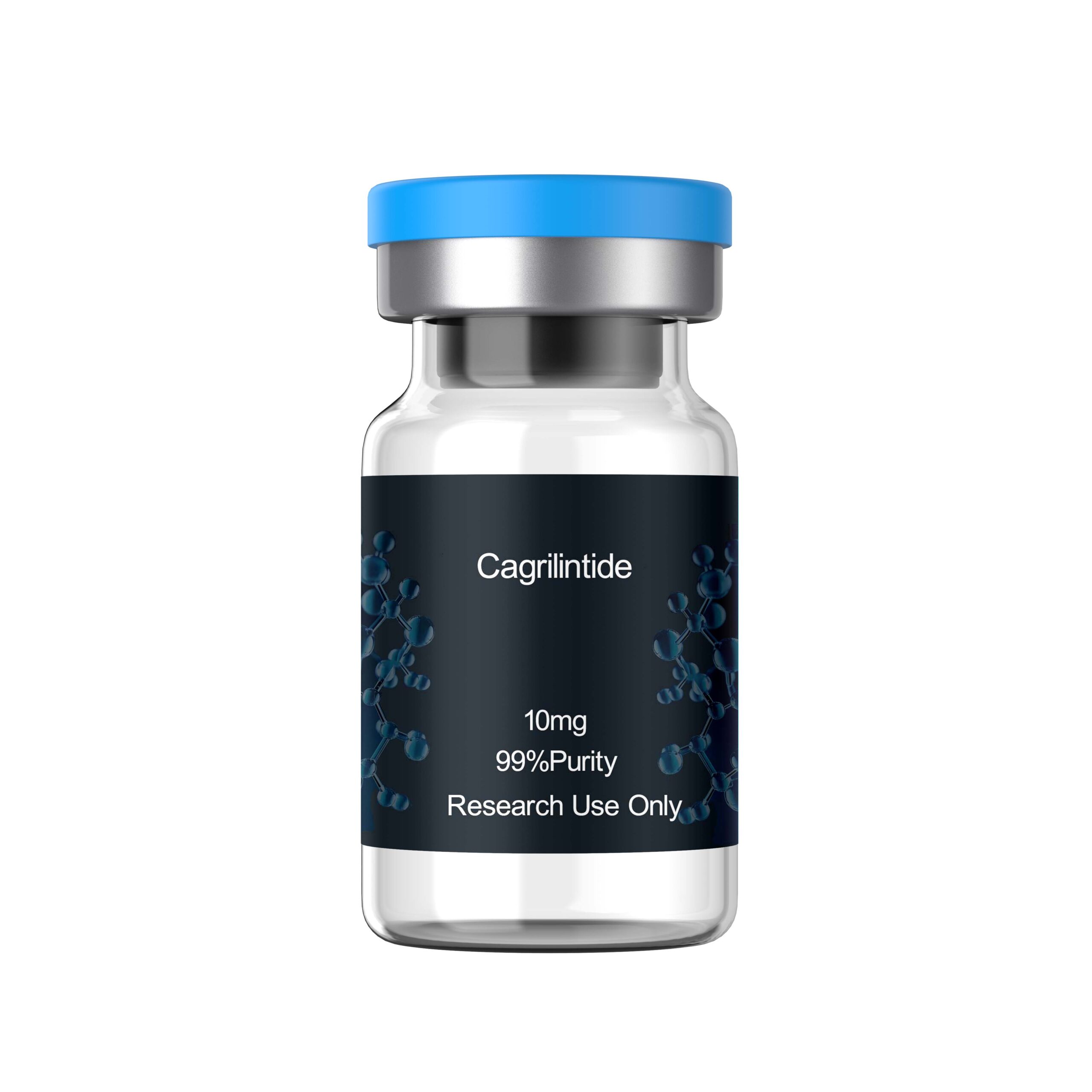
Cagrilintide Peptide A Professional Overview
Common Name & Drug Name: Cagrilintide. Cagrilintide is a drug developed by Novo Nordisk under the investigational code AM833 and is the subject of many studies. Cagrilintide is part of the investigational combination of the drug CagriSema. In laboratory and experimental studies, it is always referred to as Cagrilintide or Cagrilintide peptide and is classified as a novel investigational peptide with no approved therapeutic drug formulation.
Type of Drug: Dual-action long-acting amylin and calcitonin receptor agonist and metabolic modulating peptide and anti-obesity and insulin-sensitizing research agent
Drug Structure: Cagrilintide is a synthetic long-acting amylin analogue that was produced from the pramlintide structure. Cagrilintide has new amino acids in its structure and was tailored to maintain a longer half-life and better resistance in comparison with the native amylin. Since it is highly soluble in water and stable in the body, it is effective for long time use in metabolic studies and trials.
Compliance & Research Disclaimer
Cagrilintide Peptide is for research use only and academic experimental purposes. It is not registered as a pharmaceutical drug, dietary supplement or an over-the-counter medicine and has no clinical use approval from the FDA, EMA or other regional medical regulatory body. The product cannot be used for human clinical diagnosis, treatment of disease, oral or intravenous administration as well as commercial off-label usage. All of the product details and research data is academic in nature and not intended as medical advice or to be construed as therapeutic claims. Local laws, institutional laboratory-management requirements, and ethical-research standards must be followed by all purchasers and researchers. We shall not be liable for any unauthorized illegal use, improper operation or non-research application of the product.
- Mechanism of Action
1.1 Activation of Receptors
Cagrilintide works by selectively activating two types of receptors: amylin receptor (AMYR) and calcitonin receptor (CALCR). The drug has a high binding potential to these receptors and does not affect other receptors rendering such mechanism of action more efficient and effective. Dual activation of the receptors leads to sustained intracellular signaling processes occurring in the central part of the brain and peripheral organs.
1.2 Metabolic & Physiological Action
Cagrilintide is an amino acid-based peptide that can be used for the effective intervention of metabolic disorders. It behaves as an amylin receptor agonist resulting in the suppression of glucagon secretion, a decreased gastric emptying rate, and an increased transmission of satiety signals via the central nervous system. The calcitonin receptor mediator activation by Cagrilintide provides extra suppression of appetite stimulation and balancing of energy consumption resulting in a decrease in visceral fat accumulation as well. Cagrilintide helps improve the body’s insulin sensitivity and regulate the blood sugar levels throughout the meal and fast periods. At the same time, Cagrilintide’s effect of body weight regulation help treat metabolic damages that result from obesity, e.g. hypoxia.
- Indications & Usage (Scientific Basis)
Cagrilintide is mainly used in scientific research and it is not approved for treating humans at this point by the FDA.
Research on the treatment of type 2 diabetes mellitus: Cagrilintide is widely studied as a way to combat postprandial hyperglycemia, glucagon metabolism, and insulin resistance based on the effects of amylin.
Research on chronic weight management: Cagrilintide is one of the main subjects of research in studies of obesity, including studies of long-term appetite suppression, fat loss, and body weight stabilization.
Research related to obstructive sleep apnea: Cagrilintide is investigated in terms of a possibility to prevent the developmentCore Metabolic Combination Investigations: Functions as an indispensable method for the examination of the metabolic synergy pathway and new combination therapy principles associated with metabolic syndrome.
- Dosage & Administration ( Standard for The Research Laboratories)
3.1 Route of Administration & Frequency
The appropriate route of administration of Cagrilintide according to the standards for laboratory use is via subcutaneous injection since this route allows for stable systemic absorption and prolonged availability corresponding with the long-acting nature of the drug Therefore, in the consideration of the long duration of action in vivo the frequency of administration is a single one in 1 day or in 2 días.
3.2 Cagrilintide Dosing Protocol
The starting dose of the drug used in animal experimentation varies from 20 to 30 mcg/kg daily for the low receptor activation levels and experimental metabolic observations. The effective research dosage is 40 to 60 mcg/kg daily and provides a hypoglycemic, appetite-suppressing and weight-management effect. The safety dose limit in experiments is set at 80 mcg/kg daily, with the final aim of avoiding unacceptable gastro-intestinal inhibition and metabolic changes. There are no fixed protocols for human monotherapy since the drug can be used for research purposes only.
3.3 Missed Dose Management
Under the protocol provided to research laboratories, missed doses do not require re-administration of medication. Researchers have to properly fix the missed dose time stamp, maintain the experimental protocol until its completion, and analyze the data accordingly. Compensatory overdoses should always be avoided to prevent normal gastric emptying delay and metabolic disorders, thus contributing to the accurate results of pre-clinical experiments.
- Dosage Forms
Cagrilintide is provided in the form of lyophilized sterile powder only that should be reconstituted with sterile bacteriostatic water before injecting subcutaneously for in vivo experiments and studying its metabolic effects. It might also be used for research purposes in vitro. All products may be considered research products and there are no approved formulations for commercial use.
- FDA Drug Legal Status
The FDA does not approve the use of Cagrilintide in commercial drugs and human health care applications since it is not included in the list of investigational peptides and its usage is limited to scientific institutions and laboratories engaged in research.
10 Preguntas frecuentes comunes sobre los péptidos
- ¿Qué es un péptido??
Respuesta: Un péptido es una cadena corta de aminoácidos unidos entre sí por enlaces peptídicos.. Es más pequeño y el cuerpo humano lo absorbe más fácilmente que las proteínas., Sirviendo como sustancia funcional fundamental en los organismos biológicos..
- ¿Cuál es la diferencia entre péptidos y proteínas??
Respuesta: La diferencia principal radica en la longitud y la estructura molecular.. Los péptidos son cadenas cortas de aminoácidos. (generalmente consta de 2 a 50 aminoácidos), mientras que las proteínas son largas, cadenas de aminoácidos complejas con estructuras tridimensionales estables. Los péptidos tienen una permeabilidad más fuerte y una eficiencia de absorción más rápida que las proteínas..
- ¿Cuáles son los principales tipos de péptidos??
Respuesta: Los péptidos se clasifican principalmente por el número de aminoácidos.: dipéptidos, tripéptidos, oligopéptidos (2–10 aminoácidos) y polipéptidos (10–50 aminoácidos). También se pueden dividir en péptidos naturales y péptidos sintéticos según sus fuentes..
- ¿Cuáles son las funciones biológicas de los péptidos??
Respuesta: Los péptidos tienen diversas actividades biológicas., incluyendo la regulación del metabolismo humano, mejorar la función inmune, promoviendo la reparación celular, antioxidante, antienvejecimiento, y ajustar los niveles hormonales. Actúan como moléculas de señalización clave y factores reguladores en el cuerpo..
- ¿Son los péptidos seguros para uso humano??
Respuesta: La mayoría de los péptidos sintéticos naturales y médicamente aprobados son muy seguros.. Tienen un peso molecular pequeño., baja toxicidad, y no se acumulará en el cuerpo. Sin embargo, Los productos peptídicos no estandarizados en dosis altas o los péptidos sintéticos impuros pueden causar una leve molestia..
- ¿Cuáles son las aplicaciones comunes de los péptidos??
Respuesta: Los péptidos se utilizan ampliamente en múltiples campos.. en biomedicina, se convierten en medicamentos terapéuticos para enfermedades endocrinas e inmunes.; en cosmetica, Se utilizan para antienvejecimiento y reparación de la piel.; en productos de salud, Sirven como complementos nutricionales para mejorar la condición física..
- ¿Puede el cuerpo humano absorber péptidos exógenos directamente??
Respuesta: Sí. A diferencia de las proteínas que deben descomponerse antes de su absorción., Los péptidos de molécula pequeña pueden ser absorbidos directamente por el tracto intestinal y la piel con una alta tasa de absorción y eficiencia de utilización., y puede ejercer rápidamente efectos biológicos en el cuerpo..
- ¿Para qué se utilizan los péptidos sintéticos??
Respuesta: Los péptidos sintéticos son cadenas de aminoácidos modificadas artificialmente.. Se utilizan principalmente para investigaciones científicas., desarrollo clínico de fármacos, producción específica de ingredientes para el cuidado de la piel, y una suplementación nutricional precisa, con mayor pureza y actividad específica que algunos péptidos naturales.
- ¿Los productos peptídicos tienen efectos secundarios??
Respuesta: Los productos peptídicos estándar casi no tienen efectos secundarios obvios para la mayoría de las personas.. Los grupos individuales pueden experimentar molestias gastrointestinales leves o sensibilidad en la piel debido a diferencias físicas o ingesta excesiva.. El uso excesivo a largo plazo puede alterar el equilibrio metabólico del cuerpo..
- ¿Cuál es la diferencia entre los péptidos de colágeno y los péptidos ordinarios??
Respuesta: Los péptidos de colágeno son un tipo específico de péptido funcional extraído y descompuesto del colágeno., dirigido principalmente a la hidratación de la piel, cuidado antiarrugas y articulaciones. Los péptidos ordinarios cubren una gama más amplia con funciones reguladoras más diversas, incluidas la inmunidad y el metabolismo., mientras que los péptidos de colágeno tienen efectos más enfocados en el cuidado de la piel y antienvejecimiento..
Todos nuestros paquetes de cables de fibra óptica tienen tambor de madera de exportación.. La dimensión de madera del cable FTTH para interiores es 50x50x32cm, longitud de entrega 3 km/tambor, La dimensión de madera del cable de fibra óptica para exteriores es de 110 cm x 110 cm x 70 cm., 0.85CBM, se puede cargar 33 tambores para un 20GP. También acepte tambores de cable personalizados de los clientes. bienvenido a contactarnos!
Cable de fibra óptica de doble funda blindado de entierro directo GYTS
Imagen del cable de fibra óptica GYTS
Elección de envío |
| Método de envío | Mensajero | Tiempo de envío |
| Envío expreso | Unión Postal Universal | 5-15 DÍA |
| fedex | 5-15 DÍA |
| Línea dedicada | USPS | 7-15 DÍA |
| fedex | 7-15 DÍA |
| DDP | | 10-20 DÍA |
 Powerae.com