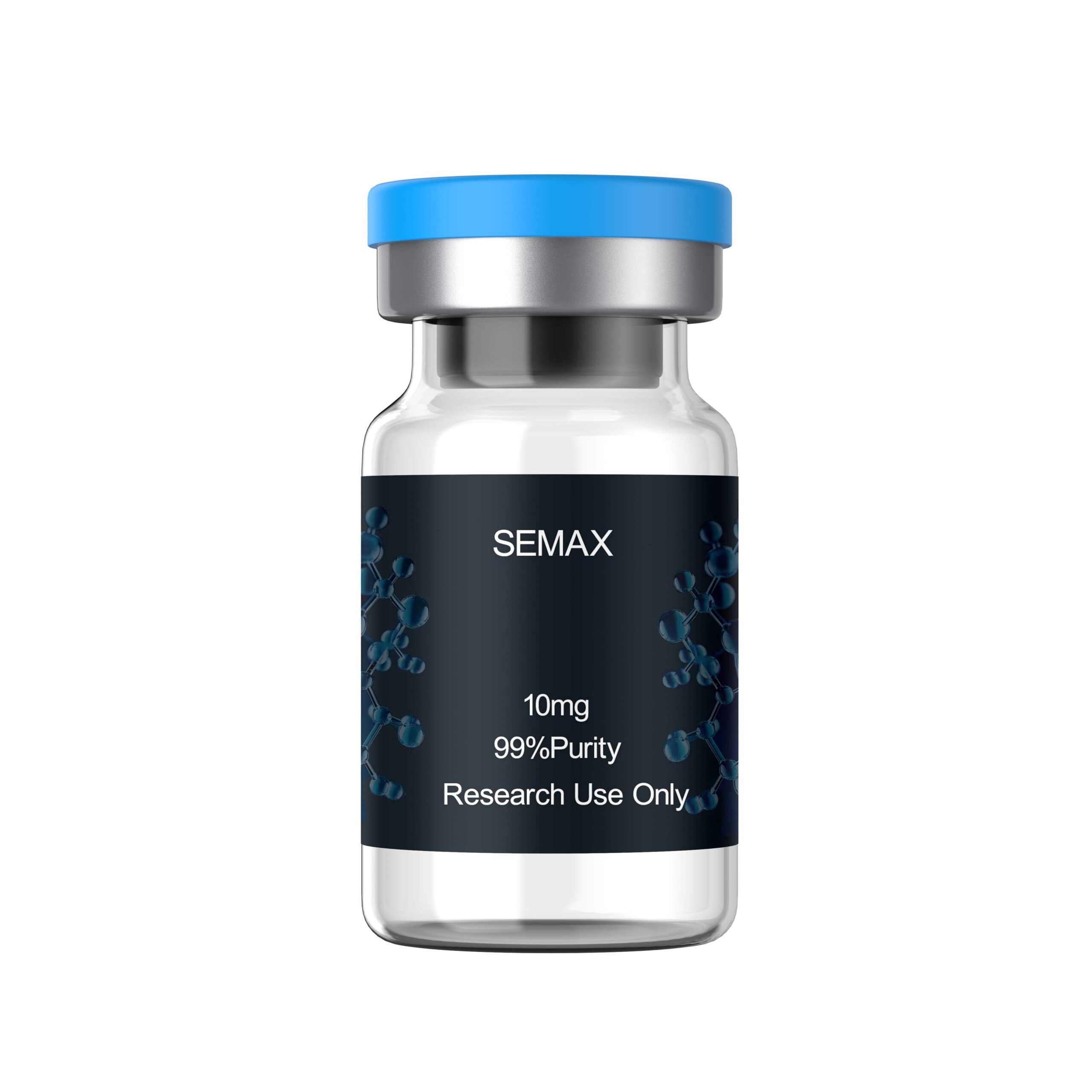
Semax Peptide is the generic name of the substance whose classification includes the neuroprotection cognitive modulator and systemic metabolism regulating peptide. Semax peptide is the synthetic bioactive peptide that has great stability and is mostly used for preclinical investigations in neuroscience, interaction between the metabolism of the brain and the body, and chronic disorders of metabolism. Semax peptide is a short modified peptide consisting of 7 amino acids and derived from the active fragment of the adrenocorticotropic hormone (ACTH). After optimizing the structure of Semax peptide and modifying its amino acid composition, the peptide gained exceptional stability in terms of enzymatic activity, permeability across BBB, and compatibility with tissues. The peptide is able to prevent rapid degradation in vivo and remain effective for a long period without causing any possible hormonal side effects. By having the specificity to the target tissues and low immune properties, Semax is very good material for research laboratories.
Mechanism of Action: Activation of Receptors and Effect on Physiology
By activating specific receptors, Semax brings about the neuroprotective and metabolism regulating effects. The peptide binds to the neurotrophic receptors and enhancers the production of brain-derived neurotrophic factor (BDNF) thus giving rise to the survival of neurons, repair of the nerves, stability of the CNS. Apart from that, Semax effects the global signaling pathways of metabolism and inflammation thus improving the microenvironment of metabolism in the tissues.Significance and Utilization of Research
This research quality Semax Peptide accomplishes three major aspects of preclinical research in metabolic sciences, being consistent with conventional peptide research paradigms. The first crucial area of research for Semax Peptide is T2DM secondary research dedicated to the investigation of Semax Peptide effectiveness in enhancing neurodermopathy and lowering the level of insulin resistance in different tissues and its ability to prevent inflammatory alterations induced by long-term hyperglycemia. The second area of Semax Peptide research is processes related to weight regulation, which is important for research devoted to implications of neuroinflammation regulation in energy metabolism efficiency and fat accumulation processes. The third area of research for Semax Peptide is the issue of sleep apnea and its protection against negative effects caused by OSA-associated hypoxia and inflammation and metabolic shifts, giving rise to new preclinical opportunities for studying problems associated with OSA. Moreover, it is widely used in studies addressing cognitive functions and mechanisms of neurorepair.
Compliance & Research Disclaimer
Mots-c Peptide is for research use only and academic experimental purposes. It is not registered as a pharmaceutical drug, dietary supplement or an over-the-counter medicine and has no clinical use approval from the FDA, EMA or other regional medical regulatory body. The product cannot be used for human clinical diagnosis, treatment of disease, oral or intravenous administration as well as commercial off-label usage. All of the product details and research data is academic in nature and not intended as medical advice or to be construed as therapeutic claims. Local laws, institutional laboratory-management requirements, and ethical-research standards must be followed by all purchasers and researchers. We shall not be liable for any unauthorized illegal use, improper operation or non-research application of the product.
Research Guidelines for Dosage and Administration
Usage and Frequency: In regular laboratory preclinical research, Semax Peptide has been used as a subcutaneous dosage form, which allows to achieve the stable absorption of the drug into the system. Most of the in vivo experiments are carried out at a frequency of once per day, which enables a stable level of drug concentration to be achieved and significant biological effects to be made. Adjustment schedule: The method of research dosage adjustment is low to high approach used in the course of the research. The beginning of the experiment is marked by a low initial dose allowing to study neural and metabolic tolerance without causing unnecessary stimulation.The dosage will be gradually raised within the stipulated research time intervals base upon predetermined research objectives and physiological responses to elicit the best outcome in anti-inflammation, neuroprotection and metabolism regulation. Moreover, all maximum dosing limits must comply with the internationally accepted preclinical research protocols. Missed Dose Management: In the event a research dose cannot be administered as scheduled, researchers should postpone dosing until the next scheduled dosing time. Dosing two times in a row to compensate for missed dose is not allowed in order to avoid physiological disruption and ensure that experimental results are accurate and reproducible.
Preparation and Properties
Our Semax Peptide is provided as sterile lyophilized powder form, which is considered the most stable way of presenting the short-chain neuroactive peptide environment. The peptide is presented as finely divided white powder with smooth texture and appearance, and the absence of caking, sedimentation or any other contamination. It has been manufactured using high-precision solid-phase peptide synthesis method and our rigorous purification and freeze-drying technology help preserve its molecular structure. Our standard research offers 5mg, 10mg, 20mg, and 30mg dosage forms in sterile vials and complies with experimental requirements for cellular neural modeling, animal neuro-metabolic experiments, and large preclinical undertakings. Each batch has been tested using HPLC technology to ensure its purity and official COA and quality report from third party institutions.
FDA Regulatory Notice: Research Use Only
In accordance with established FDA regulations, our Semax Peptide is solely intended for laboratory research practices and preclinical testing only. The product is unfit for utilization in human treatment, testing, or even cosmetic use. Hence, any human application, clinical performance or commercial use is strictly prohibited.
10 FAQ courantes sur les peptides
- Qu'est-ce qu'un peptide?
Répondre: Un peptide est une courte chaîne d'acides aminés liés entre eux par des liaisons peptidiques.. Il est plus petit et plus facilement absorbé par le corps humain que les protéines, servir de substance fonctionnelle fondamentale dans les organismes biologiques.
- Quelle est la différence entre les peptides et les protéines?
Répondre: La principale différence réside dans la longueur et la structure moléculaires. Les peptides sont de courtes chaînes d'acides aminés (composé généralement de 2 à 50 acides aminés), alors que les protéines sont longues, chaînes d'acides aminés complexes avec des structures tridimensionnelles stables. Les peptides ont une perméabilité plus forte et une efficacité d'absorption plus rapide que les protéines.
- Quels sont les principaux types de peptides?
Répondre: Les peptides sont principalement classés selon le nombre d'acides aminés: dipeptides, tripeptides, oligopeptides (2–10 acides aminés) et polypeptides (10–50 acides aminés). Ils peuvent également être divisés en peptides naturels et peptides synthétiques selon leurs sources..
- Quelles sont les fonctions biologiques des peptides?
Répondre: Les peptides ont diverses activités biologiques, y compris la régulation du métabolisme humain, améliorer la fonction immunitaire, favoriser la réparation cellulaire, anti-oxydation, anti-âge, et ajuster les niveaux d'hormones. Ils agissent comme des molécules de signalisation clés et des facteurs régulateurs dans l’organisme..
- Les peptides sont-ils sans danger pour l’usage humain?
Répondre: La plupart des peptides synthétiques naturels et médicalement approuvés sont hautement sûrs. Ils ont un petit poids moléculaire, faible toxicité, et ne s'accumulera pas dans le corps. Cependant, les produits peptidiques à forte dose non standardisés ou les peptides synthétiques impurs peuvent provoquer un léger inconfort.
- Quelles sont les applications courantes des peptides?
Répondre: Les peptides sont largement utilisés dans de multiples domaines. En biomédecine, ils sont transformés en médicaments thérapeutiques pour les maladies endocriniennes et immunitaires; en cosmétique, ils sont utilisés pour l'anti-âge et la réparation de la peau; dans les produits de santé, ils servent de compléments nutritionnels pour améliorer la forme physique.
- Le corps humain peut-il absorber directement les peptides exogènes?
Répondre: Oui. Contrairement aux protéines qui doivent être décomposées avant absorption, les peptides à petites molécules peuvent être directement absorbés par le tractus intestinal et la peau avec un taux d'absorption et une efficacité d'utilisation élevés, et peut rapidement exercer des effets biologiques sur le corps.
- A quoi servent les peptides synthétiques?
Répondre: Les peptides synthétiques sont des chaînes d'acides aminés artificiellement personnalisées. Ils sont principalement utilisés pour la recherche scientifique, développement de médicaments cliniques, production ciblée d’ingrédients de soins de la peau, et une supplémentation nutritionnelle précise, avec une pureté et une activité ciblée supérieures à celles de certains peptides naturels.
- Les produits peptidiques ont-ils des effets secondaires?
Répondre: Les produits peptidiques standards n’ont presque aucun effet secondaire évident pour la plupart des gens. Les groupes individuels peuvent ressentir un léger inconfort gastro-intestinal ou une sensibilité cutanée en raison de différences physiques ou d'une consommation excessive.. Une consommation excessive à long terme peut perturber l’équilibre métabolique de l’organisme..
- Quelle est la différence entre les peptides de collagène et les peptides ordinaires?
Répondre: Les peptides de collagène sont un type spécifique de peptide fonctionnel extrait et décomposé du collagène., ciblant principalement l'hydratation de la peau, soin anti-rides et articulations. Les peptides ordinaires couvrent une gamme plus large avec des fonctions de régulation plus diverses, notamment l'immunité et le métabolisme., tandis que les peptides de collagène ont des effets de soin et anti-âge plus ciblés..
Tous nos paquets de câbles à fibres optiques sont dotés d'un tambour en bois d'exportation. La dimension en bois du câble FTTH intérieur est de 50x50x32cm, longueur de livraison 3 km/tambour, La dimension en bois du câble à fibre optique extérieur est de 110 cm x 110 cm x 70 cm., 0.85CBM, peut être chargé environ 33 tambours pour un 20GP. Acceptez également les tambours de câble personnalisés des clients. bienvenue à nous contacter!
Câble à fibre optique blindé simple à double gaine à enterrement direct GYTS
Image du câble à fibre optique GYTS
Choix d'expédition |
| Méthode d'expédition | Courrier | Délai d'expédition |
| Expédition express | UPS | 5-15 JOUR |
| FedEx | 5-15 JOUR |
| Ligne dédiée | USPS | 7-15 JOUR |
| FedEx | 7-15 JOUR |
| DDP | | 10-20 JOUR |
 Powerae.com