Présentation du produit
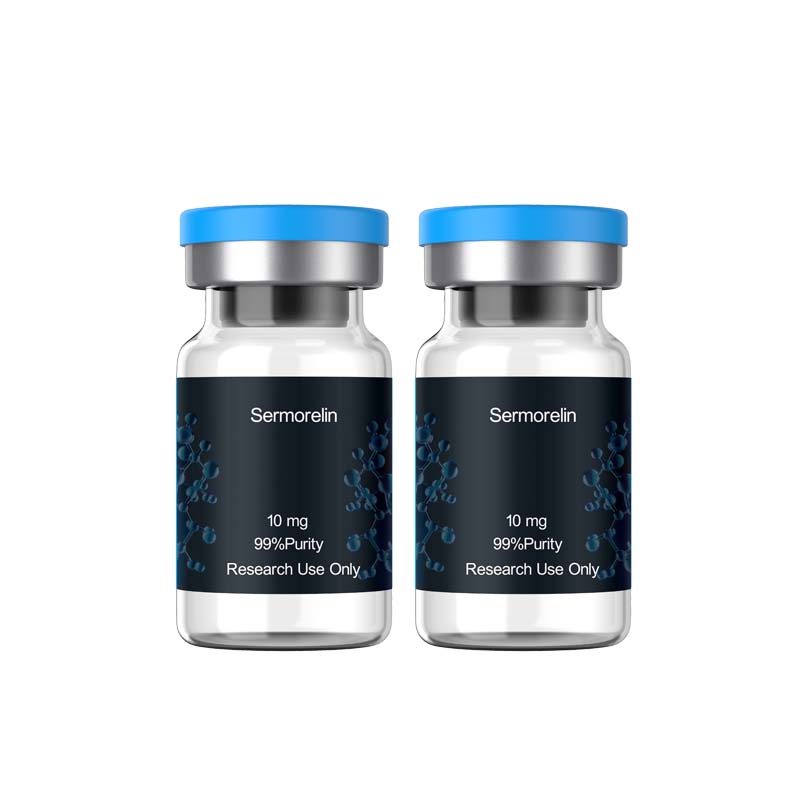
Sermorelin peptide is an acetylated GRF (1-29) also called Sermorelin Acetate, a high-purity synthetic peptide analog of growth hormone-releasing hormone (GHRH) found in humans. Structurally, it comprises the first 29 amino acid residues of the natural GHRH sequence (44-amino-acid GHRH sequence), which was determined to be a minimal bioactive fragment that fully binds and activates human GHRH receptors. This peptide is much more stable, less costly to produce and a reproducible biological activity compared with full-length GHRH (23) having a chemical structure of 3357.92 g/mol. Sermorelin is available in bulk in clinical and laboratory research, and it essentially produces GH secretagogues by exerting a stimulating effect on the activity of the anterior pituitary where GH release occurs naturally as an endogenous secretion (via a pulsatile mechanism) without addressing what could be adverse feedback inhibition risks associated with exogenous failures to provide ideal supplementation for GH. It has emerged as a central research instrument in the fields of endocrinology, metabolic physiology, and aging-related biomedical research.
Product Research Background
Sermorelin was discovered as part of peptide research in the 1980s, when scientists first isolated and sequenced human GHRH from endogenous sources. Pharmacological studies demonstrated that the initial 29 amino acid N-terminal [1-29] fragment of GHRH retained full physiological activity, whilst downstream C-terminal fragments had no significant effect on receptor binding and signal transduction. This important discovery set the stage for the development of Sermorelin. This was followed by a number of clinical and preclinical trials in subsequent decades that confirmed its safety and efficacy in governing the GH axis. After gaining FDA approval for clinical adjuvant diagnosis and growth hormone deficiency investigations, Sermorelin was slowly removed from commercial clinical usage due to market adjustment needs instead of some sort of parameters rather than safety problems. To date, one of the most investigated GHRH analogs with extensive published literature supporting its use in elucidating growth regulation, metabolic homeostasis, and hormonal changes accompanying aging.
Compliance & Research Disclaimer
This peptide product of Sermorelin is intended solely for use in scientific laboratory research and academic study. Human clinical use, medical diagnosis, treatment or personal consumption is not approved. The product meets the internationally accepted specifications for peptide research reagent production and regional laboratory material management regulations. The products and data that you have provided in this section on the site are for educational writing or experimental testing purposes only and not intended for commercial medical use or non-label use. It is incumbent on researchers and purchasers to comply fully with local laws, regulations and institutional laboratory management requirements. We disclaim all liabilities arising from any unauthorized clinical application, improper use or unlawful operation of the product. No product description and research data represent or guarantee any medical efficacy or therapeutic effect.
Applications de laboratoire
Sermorelin peptide is widely used as an essential research reagent in many modern biomedical laboratories with standardized applications for various research directions. Firstly, it has been extensively applied in the study of GH axis physiology which enables scholars to analyze the regulatory mechanism of hypothalamic-pituitary growth hormone secretion and explore endogenous hormones constituting a feedback regulation loop between various levels of intra- and extra-brain nuclei. Secondly, it has a role in research of growth hormone deficiency and developmental disorders, providing experimental data for in-depth studies on the pathogenesis and intervention strategies of abnormal stature. Third, it is used in the field of aging biology to determine whether age-related decline in GH secretion contribute to metabolic aging and/or the loss of organ function or body composition. Sermorelin is also used in experiments to detect pituitary reserve function, and for studies of metabolic regulation using in vitro and/or animal models which assist researchers when validating the effect of peptide intervention on cell growth activity, lipid metabolism and energy balance. It has biological effects that are stable and repeatable, which ensures high reliability for experimental data.
Normes de qualité
We follow international standards for peptide production and determination to supply high quality options for research use only. Your product has a normal molecular formula of C149H246N44O42S and an amino acid sequence as follows, with complete concordance to the authoritative GRF (1-29) specification. Immune defence efficacy for all batches: HPLC-tested with guaranteed purity - ≥ 98% (free from irrelevant peptide fragments, impurities and heavy metal residues.) The first verification of molecular weight and structure provides the verifying point for every batch block through mass spectrometry (MS). It is produced at a GMP compliant clean laboratory, supplied in standardised lyophilized powder packaging to prevent degradation and contamination. Before delivering, it is stringently checked for microbial limit testing, endotoxin detection and stability testing. With each batch, a full quality inspection report — purity, structure verification results and safety test indicators are all provided so that you can guarantee experimental consistency and repeatability.
Frequently Asked Questions (FAQ)
Q1: What are its 3 main benefits compared to full-length GHRH? Répondre 1: Sermorelin is a minimal active fragment of GHRH with better chemical stability, longer half-life of degradation and more stable biological activity in experiment. As it is less expensive, more stable and easier to store and transport than full-length GHRH, it is more appropriate for long-term use and large-scale laboratory studies.
Q2: Under what conditions should you store Sermorelin peptide?
Q2 — How do you store the lyophilized powder? A2: The lyophilized powder should be dry, dark and steriled in -20 °C and avoid repeated freezing–thawing. After reconstitution with sterile water, it should be used as soon as possible and can only be stored at a low temperature in refrigerator for a short time (i.e., activity loss).
T3: Is it appropriate for in vivo and in vitro experiments?
A3: Oui. It has stable biological activity and low endotoxin, which meets the requirement of mainstream biomedical experiments: Our high-purity Sermorelin can be applied to in vitro cell-level mechanism research experiments and in vivo animal model experimental research through various routes of administration.
Q4: Is your product for use in human medicine?
A4: Absolutely not. Clause de non-responsabilité: This product is a professional laboratory research reagent only, not a pharmaceutical product. It does not allow for any human body injection, treatment or clinical auxiliary application.
10 FAQ courantes sur les peptides
- Qu'est-ce qu'un peptide?
Répondre: Un peptide est une courte chaîne d'acides aminés liés entre eux par des liaisons peptidiques.. Il est plus petit et plus facilement absorbé par le corps humain que les protéines, servir de substance fonctionnelle fondamentale dans les organismes biologiques.
- Quelle est la différence entre les peptides et les protéines?
Répondre: La principale différence réside dans la longueur et la structure moléculaires. Les peptides sont de courtes chaînes d'acides aminés (composé généralement de 2 à 50 acides aminés), alors que les protéines sont longues, chaînes d'acides aminés complexes avec des structures tridimensionnelles stables. Les peptides ont une perméabilité plus forte et une efficacité d'absorption plus rapide que les protéines.
- Quels sont les principaux types de peptides?
Répondre: Les peptides sont principalement classés selon le nombre d'acides aminés: dipeptides, tripeptides, oligopeptides (2–10 acides aminés) et polypeptides (10–50 acides aminés). Ils peuvent également être divisés en peptides naturels et peptides synthétiques selon leurs sources..
- Quelles sont les fonctions biologiques des peptides?
Répondre: Les peptides ont diverses activités biologiques, y compris la régulation du métabolisme humain, améliorer la fonction immunitaire, favoriser la réparation cellulaire, anti-oxydation, anti-âge, et ajuster les niveaux d'hormones. Ils agissent comme des molécules de signalisation clés et des facteurs régulateurs dans l’organisme..
- Les peptides sont-ils sans danger pour l’usage humain?
Répondre: La plupart des peptides synthétiques naturels et médicalement approuvés sont hautement sûrs. Ils ont un petit poids moléculaire, faible toxicité, et ne s'accumulera pas dans le corps. Cependant, les produits peptidiques à forte dose non standardisés ou les peptides synthétiques impurs peuvent provoquer un léger inconfort.
- Quelles sont les applications courantes des peptides?
Répondre: Les peptides sont largement utilisés dans de multiples domaines. En biomédecine, ils sont transformés en médicaments thérapeutiques pour les maladies endocriniennes et immunitaires; en cosmétique, ils sont utilisés pour l'anti-âge et la réparation de la peau; dans les produits de santé, ils servent de compléments nutritionnels pour améliorer la forme physique.
- Le corps humain peut-il absorber directement les peptides exogènes?
Répondre: Oui. Contrairement aux protéines qui doivent être décomposées avant absorption, les peptides à petites molécules peuvent être directement absorbés par le tractus intestinal et la peau avec un taux d'absorption et une efficacité d'utilisation élevés, et peut rapidement exercer des effets biologiques sur le corps.
- A quoi servent les peptides synthétiques?
Répondre: Les peptides synthétiques sont des chaînes d'acides aminés artificiellement personnalisées. Ils sont principalement utilisés pour la recherche scientifique, développement de médicaments cliniques, production ciblée d’ingrédients de soins de la peau, et une supplémentation nutritionnelle précise, avec une pureté et une activité ciblée supérieures à celles de certains peptides naturels.
- Les produits peptidiques ont-ils des effets secondaires?
Répondre: Les produits peptidiques standards n’ont presque aucun effet secondaire évident pour la plupart des gens. Les groupes individuels peuvent ressentir un léger inconfort gastro-intestinal ou une sensibilité cutanée en raison de différences physiques ou d'une consommation excessive.. Une consommation excessive à long terme peut perturber l’équilibre métabolique de l’organisme..
- Quelle est la différence entre les peptides de collagène et les peptides ordinaires?
Répondre: Les peptides de collagène sont un type spécifique de peptide fonctionnel extrait et décomposé du collagène., ciblant principalement l'hydratation de la peau, soin anti-rides et articulations. Les peptides ordinaires couvrent une gamme plus large avec des fonctions de régulation plus diverses, notamment l'immunité et le métabolisme., tandis que les peptides de collagène ont des effets de soin et anti-âge plus ciblés..
Tous nos paquets de câbles à fibres optiques sont dotés d'un tambour en bois d'exportation. La dimension en bois du câble FTTH intérieur est de 50x50x32cm, longueur de livraison 3 km/tambour, La dimension en bois du câble à fibre optique extérieur est de 110 cm x 110 cm x 70 cm., 0.85CBM, peut être chargé environ 33 tambours pour un 20GP. Acceptez également les tambours de câble personnalisés des clients. bienvenue à nous contacter!
Câble à fibre optique blindé simple à double gaine à enterrement direct GYTS
Image du câble à fibre optique GYTS
Choix d'expédition |
| Méthode d'expédition | Courrier | Délai d'expédition |
| Expédition express | UPS | 5-15 JOUR |
| FedEx | 5-15 JOUR |
| Ligne dédiée | USPS | 7-15 JOUR |
| FedEx | 7-15 JOUR |
| DDP | | 10-20 JOUR |
 Powerae.com